You found a hole in your favorite wool sweater. Then a bald patch near the edge of the rug. Then a tiny, striped, hairy thing crawling out from under the sofa, and suddenly the last three months of mystery damage makes sense.
Carpet beetles are one of the few household pests that can live in a home for the better part of a year before anyone notices them. By then they’ve usually chewed through more than one thing you cared about.
The good news: they are beatable without moving out or replacing your carpet. The bad news: swatting the adults you see does almost nothing. Here’s a guide by Best Carpet Dubai that actually works.
What Are Carpet Beetles (And Why the Larvae Are the Real Problem)
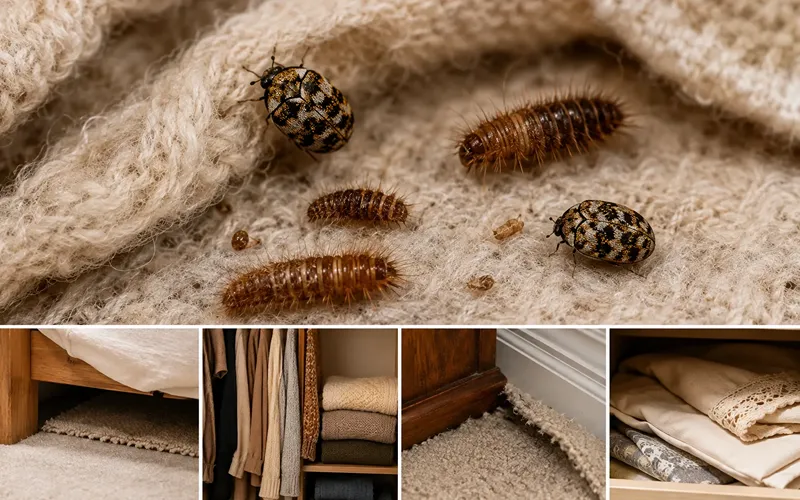
Carpet beetles belong to the Dermestidae family, a group of insects built to eat keratin, the protein in animal hair, feathers, wool, silk, leather and fur. Adults are small, oval and unremarkable: roughly 1/8 to 3/16 of an inch, about the size of a small ant.
Here’s the part most people get wrong. Adult wall to wall carpet beetles don’t eat your things. Once they mature, they live on pollen and nectar and spend most of their time outdoors or bumping around your windowsills looking for a way out. The damage is done entirely by the larvae.
Carpet beetle larvae are longer than the adults, cigar-shaped, brownish-red to nearly black, and covered in bristly hairs, which is why some people call them “woolly bears.” They avoid light, stay glued to their food source, and grow in exactly the places you never look: under the bed, inside closets, along carpet edges pinned beneath heavy furniture, in the folds of stored linens.
Three Species You’re Most Likely to Find
Varied carpet beetle, mottled white, brown and yellow scales on the back. The most common one in homes, and the least fussy eater. It will go after carpet, clothing, upholstery and stored grains.
Black carpet beetle, shiny, solid dark brown to black, slightly larger. Strongly drawn to keratin-heavy items like wool coats, fur, feather pillows and animal hair.
Furniture carpet beetle, similar mottling to the varied species but favours upholstered furniture, working from the inside of cushions outward.
You don’t strictly need to identify the species to treat them. But knowing which one you have tells you where to look hardest.
The Life Cycle That Makes Them So Hard to Kill
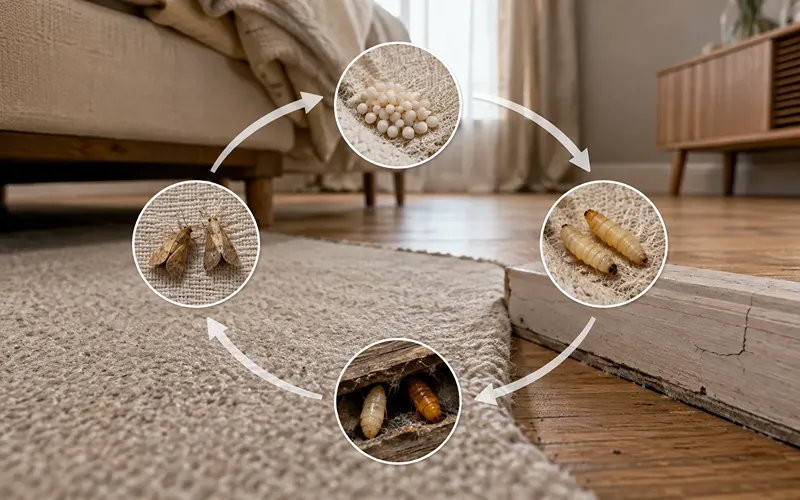
A single female lays around 40 eggs, usually tucked into fabric folds, baseboard cracks or the underside of furniture. Those eggs hatch in roughly two weeks. The larval stage, the destructive one, can then run anywhere from seven to ten months, and in cool or food-scarce conditions, considerably longer.
That’s the whole problem in one sentence: every life stage is present in your home at the same time, and each one hides somewhere different. A treatment that kills adults leaves the larvae. A treatment that kills larvae leaves the eggs. This is why one-shot solutions fail and why anyone promising instant eradication is selling something.
7 Signs You Have a Carpet Beetle Infestation
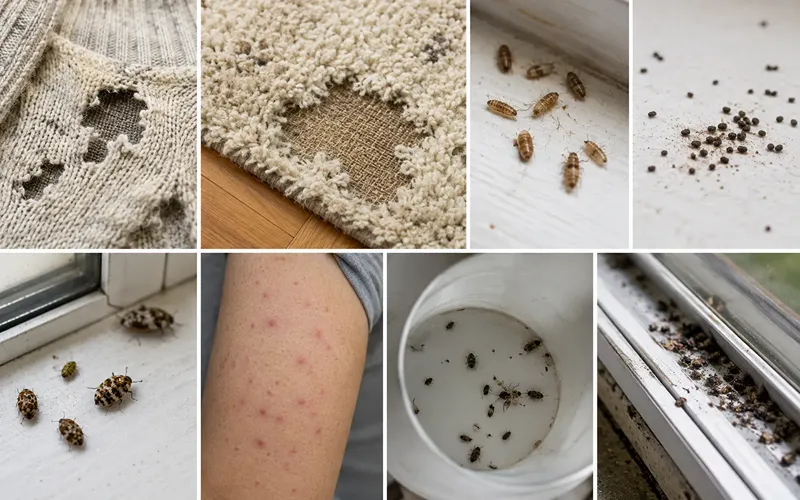
Before you treat, confirm you’re dealing with the right pest. Look for:
- Irregular holes in natural-fibre fabrics. Sisal Carpet beetle damage has rough, ragged edges and clusters together in one concentrated area. Clothes moths, by contrast, graze the surface and leave scattered, cleaner-edged holes.
- Bald or thinning patches on wool rugs, usually where the rug sits undisturbed under a bed or heavy furniture.
- Shed larval skins. Papery, translucent brown husks that look like the larvae themselves but are empty. Check closet corners, along baseboards, and the seams of upholstery.
- Fecal pellets, dark specks roughly the size and colour of coarse ground pepper, often mistaken for dirt.
- Adults on windowsills, alive or dead. Adults are drawn to light and head for windows when they’re ready to leave. Finding them indoors means the larvae developed inside your house.
- An unexplained itchy rash that keeps coming back, especially on exposed arms and legs.
- More dead insects than usual in light fixtures, window tracks or the attic. Carpet beetles feed on dead insects, so an accumulation gives them a food supply you never knew you were providing.
Carpet Beetles vs. Bed Bugs vs. Clothes Moths
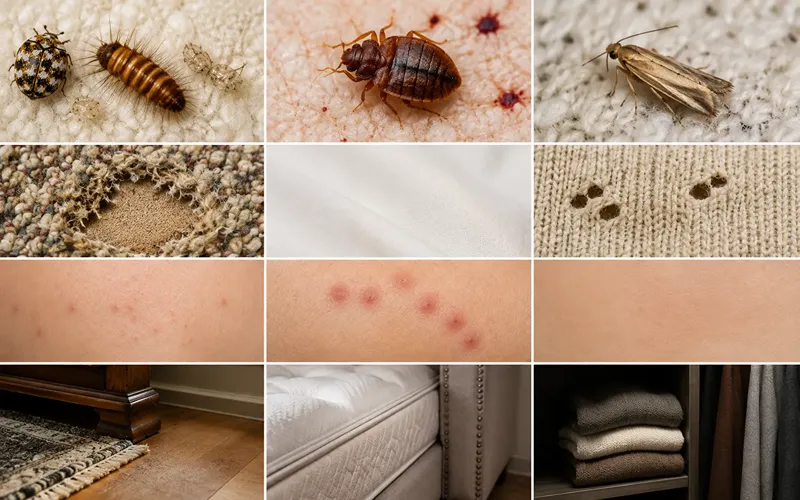
| Carpet beetles | Bed bugs | Clothes moths | |
| What you see | Bristly larvae + shed skins | Flat reddish adults, blood spots | Small beige moths, silky webbing |
| Fabric damage | Ragged holes, bald patches | None | Small surface-grazed holes |
| Skin reaction | Random, scattered rash, no puncture mark | Clustered or lined bites with a central puncture | None |
| Where they hide | Closets, rug edges, under furniture | Mattress seams, headboards | Dark closets, wool storage |
If you’re seeing rash marks with no puncture point and no blood spotting on your sheets, carpet beetles are the far more likely culprit.
Tools You’ll Need
You don’t need all of this on day one. The first four items handle the bulk of the work; the rest fill in as you move from removal to prevention.
Essentials
- Vacuum cleaner with a crevice tool, ideally a sealed HEPA model. The crevice attachment matters more than the machine; carpet edges and baseboard gaps are where the larvae live.
- Steam cleaner, for carpets, rugs, upholstery and mattresses. Reaches the eggs a vacuum leaves behind.
- Heavy-duty plastic bags, for sealing infested items, bagging vacuum contents, and freezer treatment.
- Dust mask and gloves, for powder application and handling infested textiles.
Treatment products
- Food-grade diatomaceous earth, non-toxic desiccant powder for crevices, closet floors and carpet edges.
- Boric acid, for working into carpet fibres or mixing into a spray. Keep away from children, pets and dark carpet.
- White vinegar, for wiping down shelves, drawers, windowsills and closet interiors.
- Spray bottle, for the vinegar solution and the diluted boric acid mix.
- Carpet beetle pheromone traps, species-specific traps, not generic sticky monitors. Doubles as your progress tracker.
- Residual insecticide labelled for carpet beetles (bifenthrin, deltamethrin, cyfluthrin or permethrin) only if cleaning alone hasn’t worked.
Prevention supplies
- Airtight storage containers or vacuum-seal bags, for wool, silk, fur and feather items. Replaces cardboard boxes and breathable garment bags, both of which larvae get through.
- Cedar blocks or cedar oil, a repellent layer for wardrobes and drawers. Sand them lightly every few months to restore the scent.
- Caulk and replacement weatherstripping, for sealing the entry points at the end of the process.
How Much Time Each Step Actually Takes
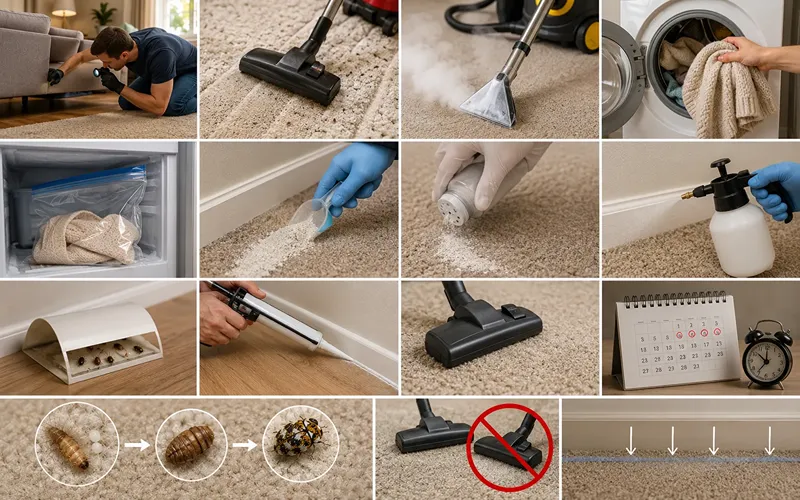
Most guides list a single number, which is misleading, several of these treatments need almost no effort but a long wait. The table below splits the two, so you can plan a weekend realistically.
| Step | Hands-on time | Wait / total elapsed |
| Locating the source | 45 min – 2 hrs | Same day |
| Deep vacuum (one room) | 30 – 45 min | Same day |
| Deep vacuum (whole house) | 2 – 4 hrs | Same day |
| Steam cleaning carpets | 1 – 2 hrs per room | Add 6 – 12 hrs drying |
| Hot-wash laundry cycle | 20 min loading | 2 – 4 hrs per load with drying |
| Freezing delicate items | 10 min to bag | 72 hrs minimum at 0°F |
| Diatomaceous earth | 20 – 30 min to apply | Leave 24 – 48 hrs, then vacuum |
| Boric acid on carpet | 20 min to apply | Leave 2 – 4 hrs, then vacuum |
| Residual insecticide | 30 – 60 min | Dry before re-entry; leave treated edges unvacuumed ~3 weeks |
| Setting pheromone traps | 10 min | Read weekly; replace every 3 months |
| Sealing entry points | 1 – 3 hrs | One-time |
| Full elimination, mild case | ~1 weekend + weekly upkeep | 2 – 4 weeks |
| Full elimination, established case | Repeat cycles | 6 – 12 weeks |
Three things worth flagging from that table.
Powder treatments are a waiting game, not a spraying game. Diatomaceous earth kills by dehydration, which takes a day or two of contact. If you vacuum it up the same afternoon, you’ve wasted the application. Plan on reapplying roughly weekly for two to three weeks so you’re catching newly hatched larvae as they emerge.
Don’t undo your insecticide. If you apply a residual product to carpet edges and baseboards, vacuuming those specific areas the next day strips the barrier before it does any work. Vacuum the open floor, leave the treated margins alone for about three weeks.
The multi-week numbers aren’t padding. Eggs laid before your treatment hatch about two weeks later regardless of what you did. That second wave is expected and doesn’t mean your effort failed — it means you need one more cycle.
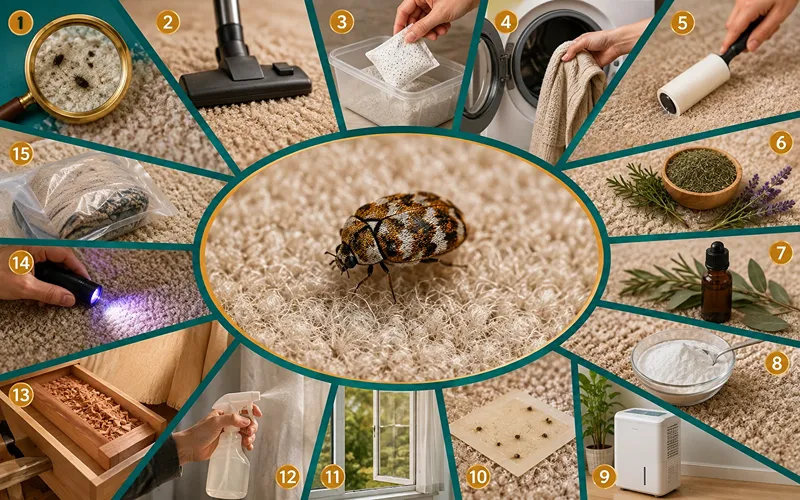
How to Get Rid of Carpet Beetles: 15 Methods That Work
Work through these roughly in order. The first six do most of the heavy lifting; the rest close the gaps.
1. Find the Source Before You Treat Anything
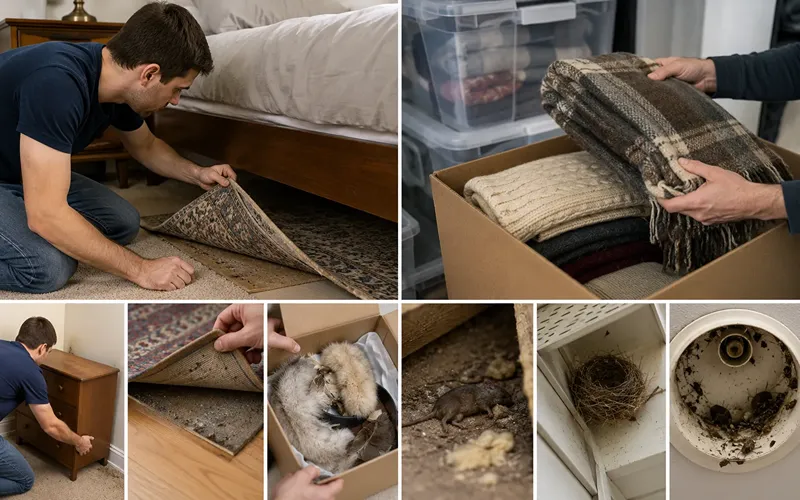
Every serious infestation has an epicentre, one item or one spot that’s been feeding the population. Until you find it, you’re just thinning the numbers.
Start with what hasn’t moved in a year: the wool rug under the bed, a box of stored blankets, an old fur or feather item at the back of a closet, a taxidermy piece, a forgotten bag of pet hair-covered bedding. Pull furniture away from walls. Lift rug corners. Open the boxes you’ve been meaning to sort.
Also check for hidden protein sources: a dead mouse in a wall void, an old bird or wasp nest in a soffit, or a pile of dead flies in a light fixture. These sustain carpet beetle colonies indefinitely.
2. Vacuum Thoroughly, Then Vacuum the Edges Again
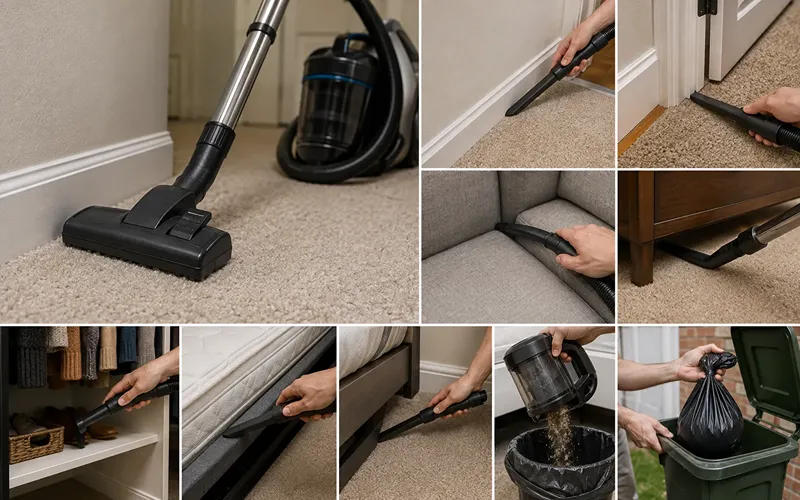
Vacuuming physically removes adults, larvae and eggs in one pass, and it’s the single highest-value thing you can do. It only works if you’re systematic about it.
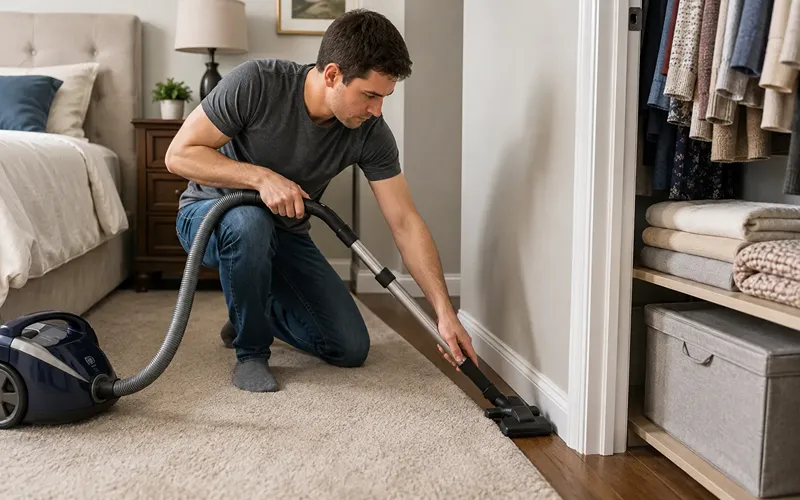
Use the crevice tool along every baseboard, in carpet edges, and where the carpet tucks under door thresholds. Vacuum under and behind furniture, inside closets, along the seams and under the cushions of upholstered chairs, and the mattress and bed frame. A vacuum with a sealed HEPA filter is worth using here, larval hairs are an irritant and you don’t want them recirculating.
When you’re done, empty the canister or bag straight into an outdoor bin. Bagged vacuums are safer: seal the bag before you carry it out.
Repeat every two or three days for the first few weeks. Once weekly after that.
3. Steam Clean Carpets, Rugs and Upholstery
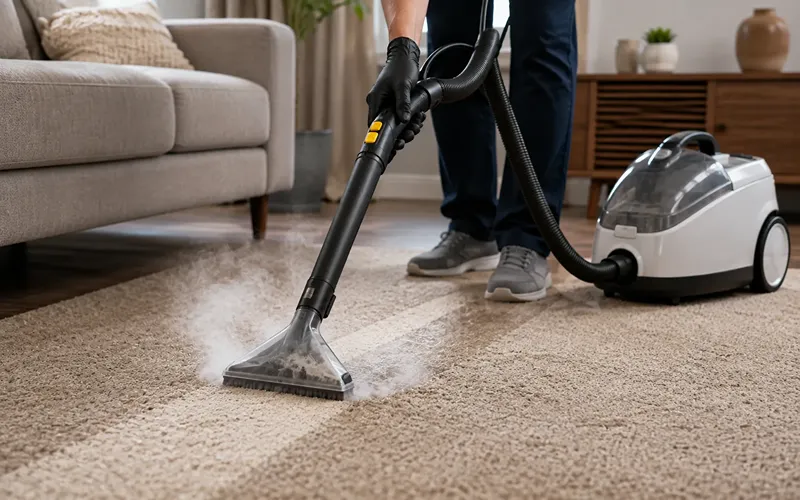
Vacuuming lifts what’s loose. Steam gets what’s embedded. The heat penetrates carpet fibres and kills eggs and larvae that a vacuum can’t dislodge, and it works on upholstery and mattresses too.
Do this immediately after a thorough vacuum, not before, and let everything dry completely, lingering damp is its own problem.
4. Launder Infested Fabrics in Hot Water

Anything washable that was near the source goes into the machine on the hottest cycle the fabric will tolerate, ideally 120°F (49°C) or above. Bedding, curtains, clothing, cushion covers, pet blankets. A high-heat tumble dry afterwards finishes off anything that survived the wash.
One detail that matters: carpet beetle larvae are drawn to soiled fabric far more than clean fabric. Sweat, food residue and body oils are food. Never store anything unwashed.
5. Freeze What You Can’t Wash
Dry-clean-only wool, silk scarves, delicate knits, vintage textiles, these can be treated by freezing instead.
Seal the item in a plastic bag, push out as much air as you can, and put it in a freezer at 0°F (-18°C) or colder for at least 72 hours. The sealed bag prevents condensation from damaging the item when you take it out. Let it return to room temperature inside the bag before opening.
For genuinely valuable items, antique rugs, heirloom textiles, talk to a conservator or a specialist cleaner instead of improvising.
6. Discard What’s Beyond Saving
This is the step people resist, and it’s often the one that ends the infestation. If a rug, cushion or garment is heavily infested and not valuable, bag it tightly, seal it, and take it out of the house today. Keeping a badly infested item “to deal with later” simply restarts the cycle after every treatment.
7. Apply Food-Grade Diatomaceous Earth
Diatomaceous earth is a fine powder made from fossilised algae. It kills mechanically rather than chemically, the microscopic particles abrade the insect’s outer layer and it dehydrates. No resistance develops, and food-grade DE is safe around most households.
Dust a light layer into carpet edges, under furniture, along baseboards, at the back of cupboards and closets, and into cracks. Light is the key word, a thick pile just gets walked around. Leave it in place for a few days, then vacuum.
Wear a dust mask while applying it. The powder is harmless but you don’t want it in your lungs.
8. Use Boric Acid on Carpets and in Cracks
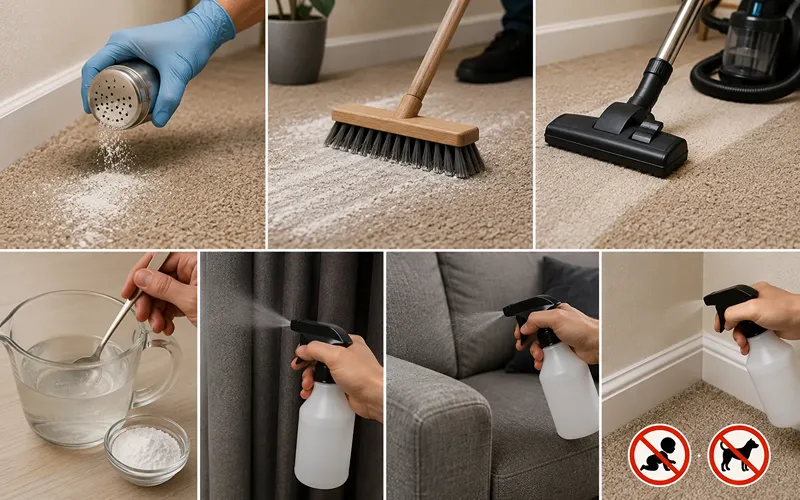
Boric acid works as a slow-acting stomach poison and is a long-standing option for carpets and rugs. Sprinkle it evenly, work it into the fibres with a soft broom, leave it a few hours, then vacuum thoroughly.
For fabric surfaces, dissolve about a tablespoon in two cups of hot water, stir until clear, and mist curtains, upholstery, baseboards and dark corners from a spray bottle.
Two cautions. Test on a hidden patch first, boric acid can leave a whitish residue, so avoid it on dark carpet. And keep children and pets away from treated areas until you’ve vacuumed up, since it’s toxic if swallowed in quantity.
9. Wipe Down Hard Surfaces with a Vinegar Solution
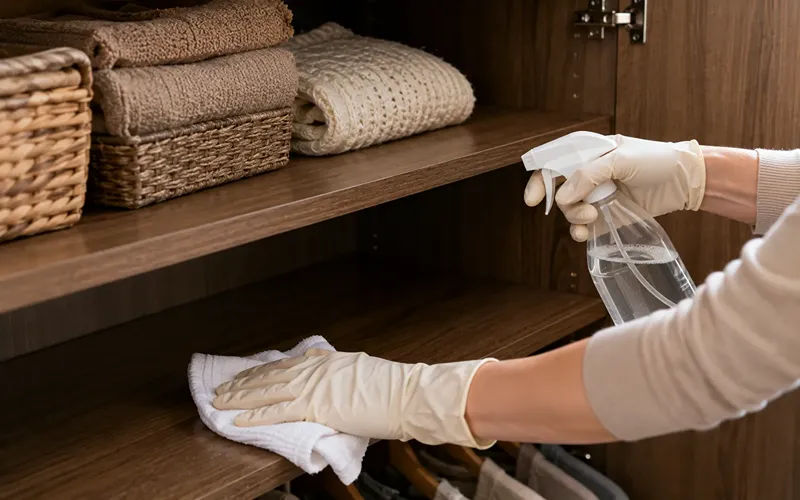
A one-to-one mix of white vinegar and water is a useful cleaning step for shelves, drawer interiors, windowsills, closet rods and cupboard corners. It removes the residue and debris that attract egg-laying females and makes the surface less appealing.
It won’t clear an established infestation on its own. Treat it as maintenance, not treatment.
10. Put Down Pheromone Traps
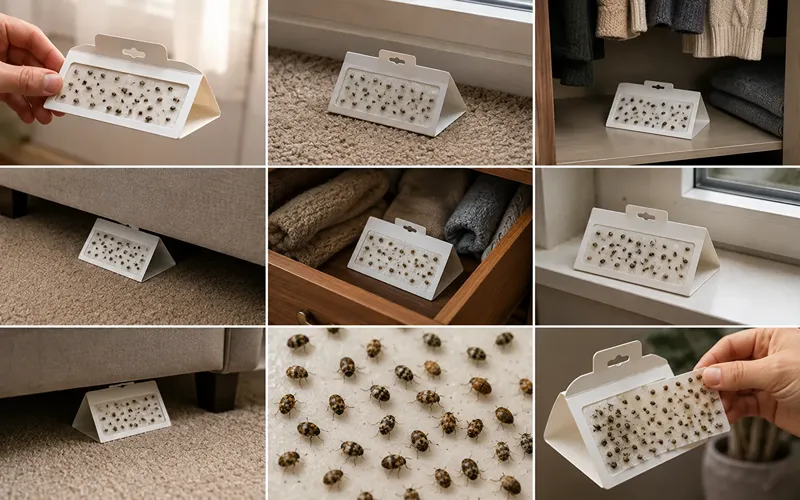
Pheromone traps use a synthetic scent to lure adult beetles onto a sticky surface. They serve two purposes: they intercept adults before they lay eggs, and, more usefully, they tell you where the activity is concentrated and whether your treatment is working.
Buy traps specifically formulated for carpet beetles, not generic sticky monitors, which won’t attract them. Place them in closets, near windows, and in the rooms where you found damage. Replace them every few months as the lure fades.
If traps in one room keep filling while others stay empty, you’ve found your epicentre.
11. Try Essential Oil Repellents

Cedarwood, clove, peppermint, lavender and neem oils all have some repellent effect. Dilute a few drops in water in a spray bottle and mist storage areas, closet shelves and drawer interiors, or hang cedar blocks in wardrobes.
Set expectations correctly: these repel, they don’t exterminate. Cedar blocks also lose potency as the aromatic oils dissipate, so sand them lightly every few months to refresh the surface. Use these as a prevention layer around clothing you’ve already cleaned.
12. Treat with a Targeted Insecticide
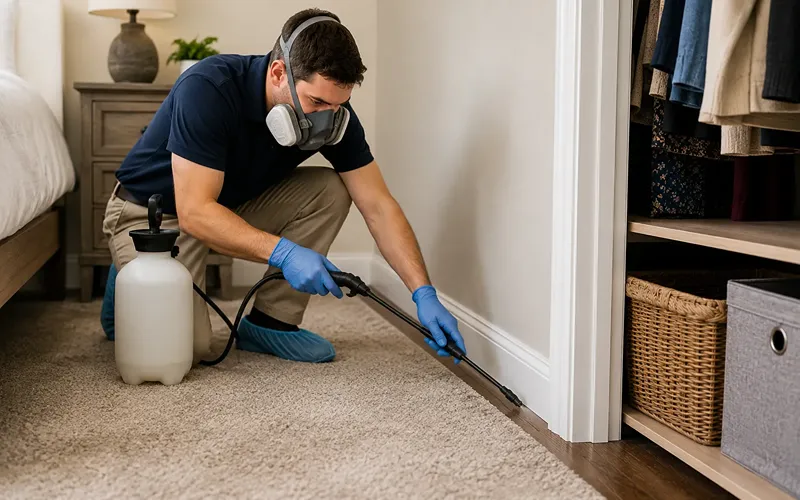
If the infestation is widespread and cleaning alone hasn’t broken it, a residual insecticide is a reasonable next step. Look for products labelled for carpet beetles containing bifenthrin, deltamethrin, cyfluthrin or permethrin.
Apply to the places larvae travel and hide, carpet edges, beneath furniture, baseboards, closet floors, cracks and crevices, not as a broadcast spray over open floor. Read the label completely before you start, test for staining on an inconspicuous patch, keep children and pets out of treated rooms until surfaces are dry, and never apply anything to bedding or clothing unless the label specifically allows it.
Skip total-release foggers. They deposit product on exposed horizontal surfaces and don’t reach a single larva living deep in a cushion or under a rug, which is where all of them are.
13. Clear Out Nests, Dead Insects and Attic Debris
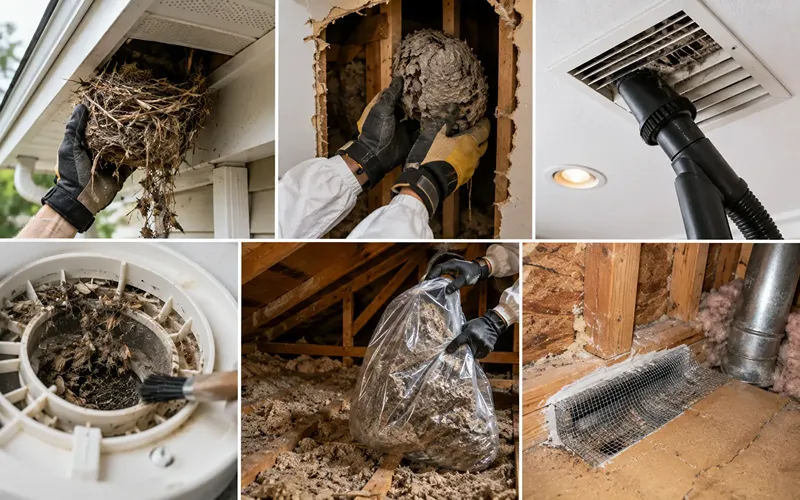
Bird nests in eaves, wasp nests in wall voids, dead insects in vents and light fixtures, accumulated lint in ducts, every one of these is a permanent carpet beetle food supply that sits outside the rooms you’ve been cleaning.
Remove them, seal the openings that allowed them, and check the attic and crawl space. This step is skipped constantly, and it’s a common reason infestations return two months after a “successful” treatment.
14. Seal Entry Points
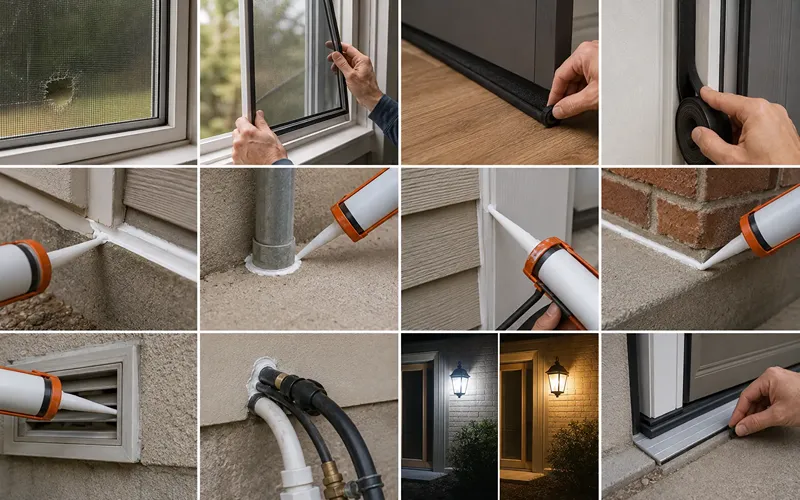
Adults get in through open windows without screens, torn screens, gaps under doors, failed weather stripping and cracks around foundations, utility penetrations and vents.
Repair the screens, replace worn weather stripping, and caulk the gaps. Adults are also drawn to light at night, so consider switching exterior lights near doors to warm-toned or yellow bulbs, which attract fewer flying insects.
15. Bring in a Professional When You’ve Hit the Ceiling
Call a pest control company if: the infestation spans multiple rooms, you’ve done a full round of the steps above and are still finding live larvae after six to eight weeks, the source is somewhere structural you can’t access, or valuable textiles are at risk.
Professionals have access to products and application equipment that reach voids and subfloor gaps you can’t, and they’ll identify the harbourage far faster than trial and error will.
9 Common Mistakes That Keep Carpet Beetles Coming Back
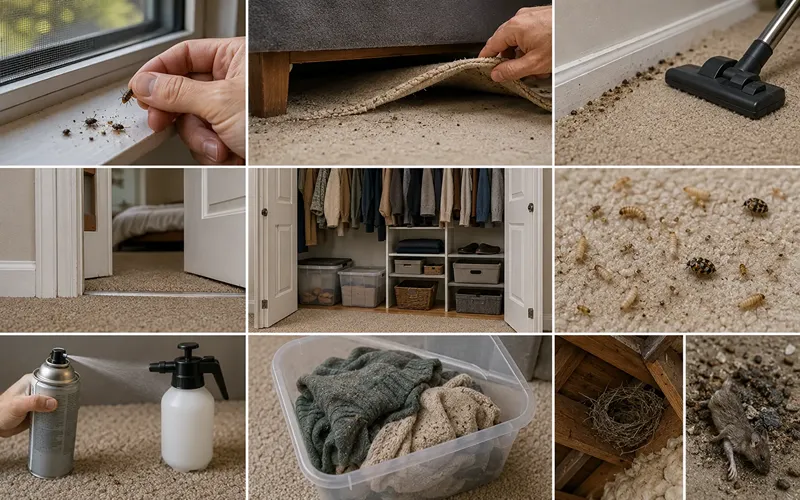
Most failed treatments aren’t failed because of the products used. They fail because of one of these.
- Treating the beetles you can see instead of the ones you can’t. Squashing adults on the windowsill feels productive and accomplishes nothing, those adults are on their way out, and they’ve already laid eggs. Every treatment should be aimed at dark, undisturbed places you haven’t looked in months.
- Never moving the furniture. The wool rug pinned under the bed frame, the corner of carpet beneath a bookcase, the underside of a sofa that hasn’t shifted since you bought it, this is where infestations start and where they survive treatment. If the vacuum head hasn’t been under it, it isn’t treated.
- Vacuuming the open floor and skipping the perimeter. Larvae don’t cross the middle of a room. They live where carpet meets baseboard, in the tack strip gap, and along door thresholds. A room can be spotless in the centre and heavily infested at the edges.
- Treating one room and stopping. Larvae migrate along baseboards and under doors; adults fly between rooms. Treat the affected room plus everything adjoining it, including the closets in both.
- Ignoring closets and storage entirely. Closets are the single most commonly overlooked zone, dark, still, and full of exactly what larvae eat. Empty the shelves, vacuum the corners and rod ends, and check inside every stored box before you declare a room clean.
- Quitting after two weeks. Around the two-week mark, a fresh batch of eggs hatches and you start finding larvae again. People read this as “the treatment didn’t work” and either give up or switch products. It’s the expected second wave. Keep the same routine going for another cycle.
- Reaching for a fogger or relying on spray alone. A total-release fogger coats exposed surfaces and reaches nothing inside a cushion, beneath a rug or in a wall void, which is where the entire population lives. Sprays are a supporting tool, not a primary one. Physical removal does the real work.
- Putting worn wool back into storage. Larvae strongly prefer soiled fabric, sweat, body oils and food residue are food. A clean sweater is a far less attractive target than the one you wore twice before folding it away. Wash or dry-clean everything before it goes into a container, without exception.
- Missing the non-fabric food sources. An old bird nest in the eaves, a wasp nest in a wall cavity, a dead rodent, or a build-up of dead flies in a light fixture will feed a colony indefinitely. If beetles keep returning to a spotless room, the food supply is somewhere structural, not somewhere textile.
One more worth naming, because it wastes the most time overall: treating for the wrong pest. A recurring itchy rash sends plenty of people down a months-long bed bug hunt. If there are no bites with a central puncture, no blood spotting on the sheets, but there are shed skins near the closet and holes in the wool, it’s carpet beetles.
How to Keep Carpet Beetles From Coming Back

Elimination is a project. Prevention is a habit, and it’s much less work.
Store Natural Fibres Properly
Clean everything before storage, no exceptions. Then store wool, silk, cashmere, fur and feather items in airtight containers or vacuum-seal bags rather than cardboard boxes or breathable garment bags, both of which larvae walk straight through. Add cedar to sealed containers if you like, and keep storage areas dry.
Build a Cleaning Routine You’ll Actually Keep
Weekly vacuuming that includes the edges and under furniture is enough for most homes. Rotate rugs seasonally so no area stays undisturbed for a year. Move heavy furniture two or three times a year and vacuum underneath. Wash bedding regularly and keep dry pantry goods, flour, grains, seeds, pet food, in sealed containers, since some species feed on these too.
Watch What Comes Through the Door
Carpet beetles are hitchhikers. The most common ways they arrive: cut flowers from the garden, second-hand clothing and rugs, thrifted upholstered furniture, and items pulled out of long-term storage.
Shake out cut flowers outside before bringing them in. Wash or freeze second-hand textiles before they touch your closet. Inspect used furniture, especially the underside and the cushion seams, before it comes inside.
How Long Does It Take to Get Rid of Carpet Beetles?
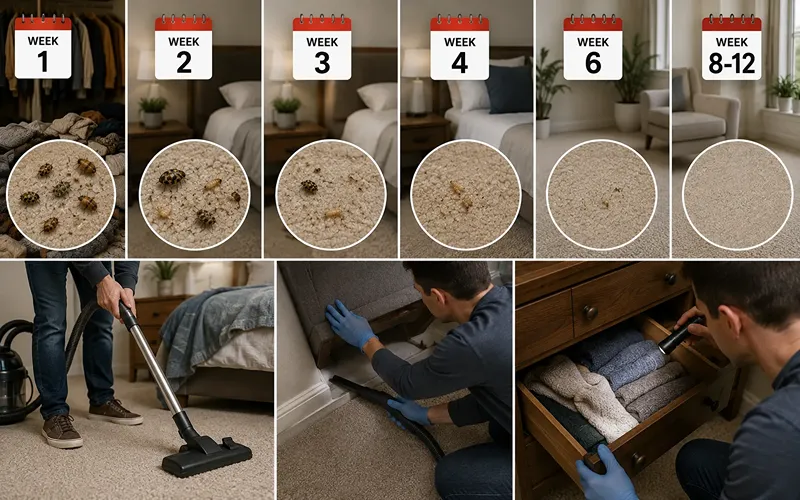
Caught early and confined to one room, expect two to four weeks of consistent effort. A well-established infestation across several rooms more often takes two to three months, sometimes longer.
The reason is arithmetic, not effort. Eggs laid the day before your treatment will hatch about two weeks later, and any larvae that were sheltered deep in a cushion or wall void when you treated will emerge afterwards. You are working through overlapping generations.
Expect to see fewer larvae each week rather than none at all. If numbers are still climbing after a month of consistent treatment, you’ve missed the source, go back to step one and search harder.
Are Carpet Beetles Dangerous?
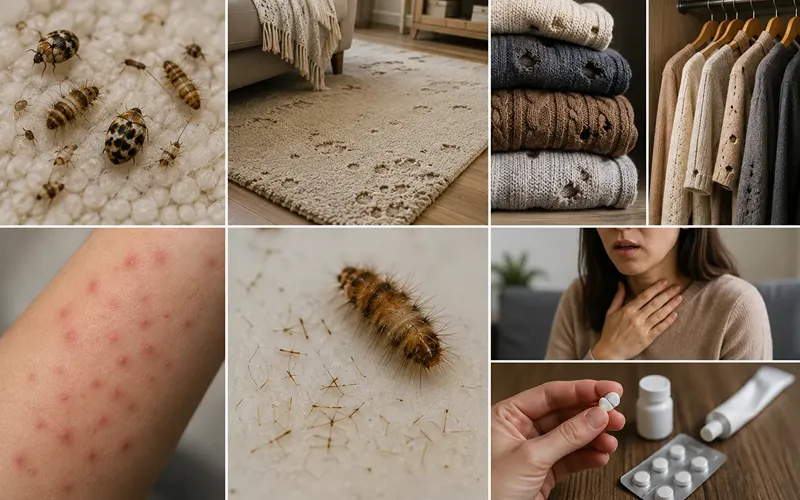
They don’t bite, they don’t sting, and they don’t transmit disease. That’s the honest answer.
What they do cause is carpet beetle dermatitis, an allergic reaction to the barbed hairs shed by the larvae. These bristles detach easily, settle into bedding and upholstery, and irritate skin on contact. The result is red, itchy bumps that look enough like insect bites that people commonly assume bed bugs and treat for the wrong pest entirely.
The distinguishing detail: bed bug bites tend to cluster or line up and have a visible central puncture. Carpet beetle rash is scattered, random, and has no puncture point.
Airborne larval hairs can also aggravate asthma and general allergy symptoms in sensitive people. The reaction clears up on its own once the source is gone; over-the-counter antihistamines and hydrocortisone cream manage the itching in the meantime. If a rash is severe, spreading, or persists after your home is clear, see a doctor rather than assuming it’s the beetles.
The real cost is property. An unchecked infestation can destroy wool rugs, wardrobes and upholstery worth thousands.
The Bottom Line
Carpet beetles win by being patient and hidden. You beat them by being systematic: find the source, remove it, vacuum and steam relentlessly, treat the edges and crevices where the larvae actually live, and then close the gaps that let them in.
Start today with the source hunt and one deep vacuum. That single afternoon will do more than a month of spraying whatever you happen to see crawling across the floor.
Frequently Asked Questions
Do carpet beetles bite?
No. What look like bites are an allergic reaction to the shed hairs of the larvae, not puncture wounds.
Can carpet beetles live in your bed?
Yes. Larvae feed on natural-fibre bedding, shed skin cells and pet hair, and hide in mattress seams, under the mattress and along the bed frame. Hot-wash bedding and vacuum the mattress thoroughly.
What kills carpet beetles instantly?
On contact: steam, a hot wash cycle, or direct vacuuming. Powders like diatomaceous earth and boric acid take hours to days. Nothing kills an entire infestation instantly, because the eggs and hidden larvae survive any single treatment.
Does baking soda kill carpet beetles?
It’s a poor treatment. Baking soda deodorises and may help slightly as a cleaning aid, but it isn’t a reliable insecticide. Diatomaceous earth is the far better powder for this job.
Will carpet beetles go away on their own?
Rarely. They leave only when the food runs out, and since they eat wool, silk, leather, pet hair, lint and dead insects, that almost never happens indoors on its own.
Can carpet beetles spread through a whole house?
Yes. Larvae migrate along baseboards and under doors, and adults fly between rooms. This is why treating one room while ignoring the rest usually fails.
Are carpet beetles a sign of a dirty house?
Not really. They arrive on flowers, second-hand goods and through open windows, and spotless homes get them too. Regular cleaning shortens an infestation, but it doesn’t prevent one from ever starting.